From negative NPS to self-serve
Redesigning Telstra Enterprise’s B2B self-serve portal around a North Star
- client
- Telstra Enterprise
- role
- UX design lead, leading 10 designers across Sydney and Bangalore
- focus
- North Star vision · Roadmapping · Design Ops · Research programs · Executive alignment
impact at a glance
- 12% → 43%
- of transactions provisioned digitally, in two years
- −36 → +12
- platform NPS
- 6,000 → 13.8K
- active enterprise customers
- 10
- designers led across Sydney and Bangalore
The problem space
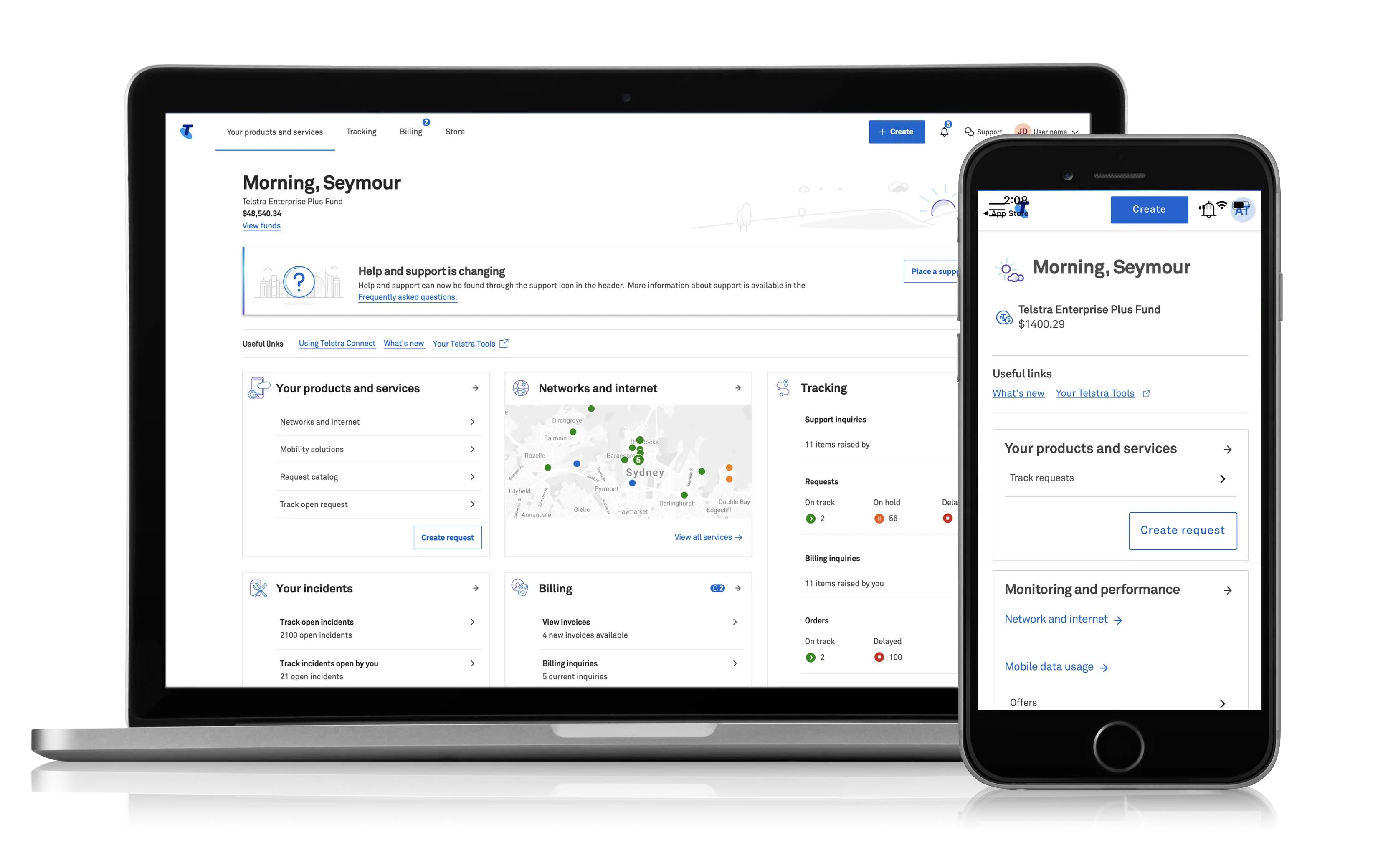
Telstra Connect is the self-serve portal enterprise customers use to manage their products and services, networks, incidents, billing and orders.
When I joined, the platform’s NPS was −36, and only 12% of transactions were provisioned digitally. Everything else went through assisted channels.
My role
As UX design lead, I led 10 designers across Sydney and Bangalore and represented design with Product, Engineering, Delivery and Architecture, presenting up to CIO and CCO level.
Process & artifacts
A North Star and an 18-month roadmap
I set out an 18-month roadmap anchored on a North Star vision for the platform, so every squad was building towards the same end state.
Research that changed the plan
I ran qualitative and quantitative research programs (interviews, usability testing, ethnography) and turned the findings into journey maps and service blueprints.
Design Ops at scale
I embedded agile cadences, Design Ops and design chapter rituals (stand-ups, critiques, leadership check-ins), and aligned workflows with the design system to speed up approvals and lift quality.
Impact
Over two years:
- Digital provisioning grew from 12% to 43% of transactions, a material shift in the service model.
- Active customers more than doubled, from 6,000 to over 13,800.
- NPS went from −36 to +12.
- Project velocity and design quality both improved.