From 11% to 85% approved
Continuous improvement of ubank’s self-serve home loan application, one leak at a time
- client
- ubank (part of NAB)
- role
- Design lead, Home Lending squad, leading a mid-level and an offshore designer
- focus
- Funnel analytics · Rapid iteration · Regulatory research · AI-assisted research · Usability testing
impact at a glance
- 11% → 85%
- unconditional approvals, 4 weeks after launch vs 12 months on
- +80%
- from getting started to submitting an application
- 26% → 1%
- validation errors at ID and connected accounts
- −9%
- applications rejected on HEM expense benchmarks
The problem space
ubank had just launched a new self-service home loan application. Customers could apply online without a banker, from their details and ID through to their income, expenses and submission.
Four weeks after launch, only 11% of applications were getting an unconditional approval. The launch was done; the work now was continuous improvement.
Looking at the funnel, applicants were being lost in three different ways, and each needed a different kind of fix:
- They gave up. The experience didn’t get them through to submit.
- They got the data wrong. Errors and bad data went into the application.
- They got declined. They submitted, but weren’t approved.
Expenses sat across the last two. It was the largest drop-off point in the application, and the most common reason customers were rejected.
My role
I was design lead in the Home Lending squad, with a mid-level designer and an offshore designer reporting to me. I worked alongside the squad’s product, engineering and data people, and with lending, risk and legal teams across the bank.
It was a 12-month contract, and the work below was all delivered within it. Most of the fixes were single-sprint changes made in response to live data. Expenses was the exception: six weeks of research and ideation before we designed anything.
Process & artifacts
Getting customers through
The first lever was simply getting more people to start and finish. Simplifying the flow to start an application, and telling customers up front what they’d need, was key. Application starts rose 26%.
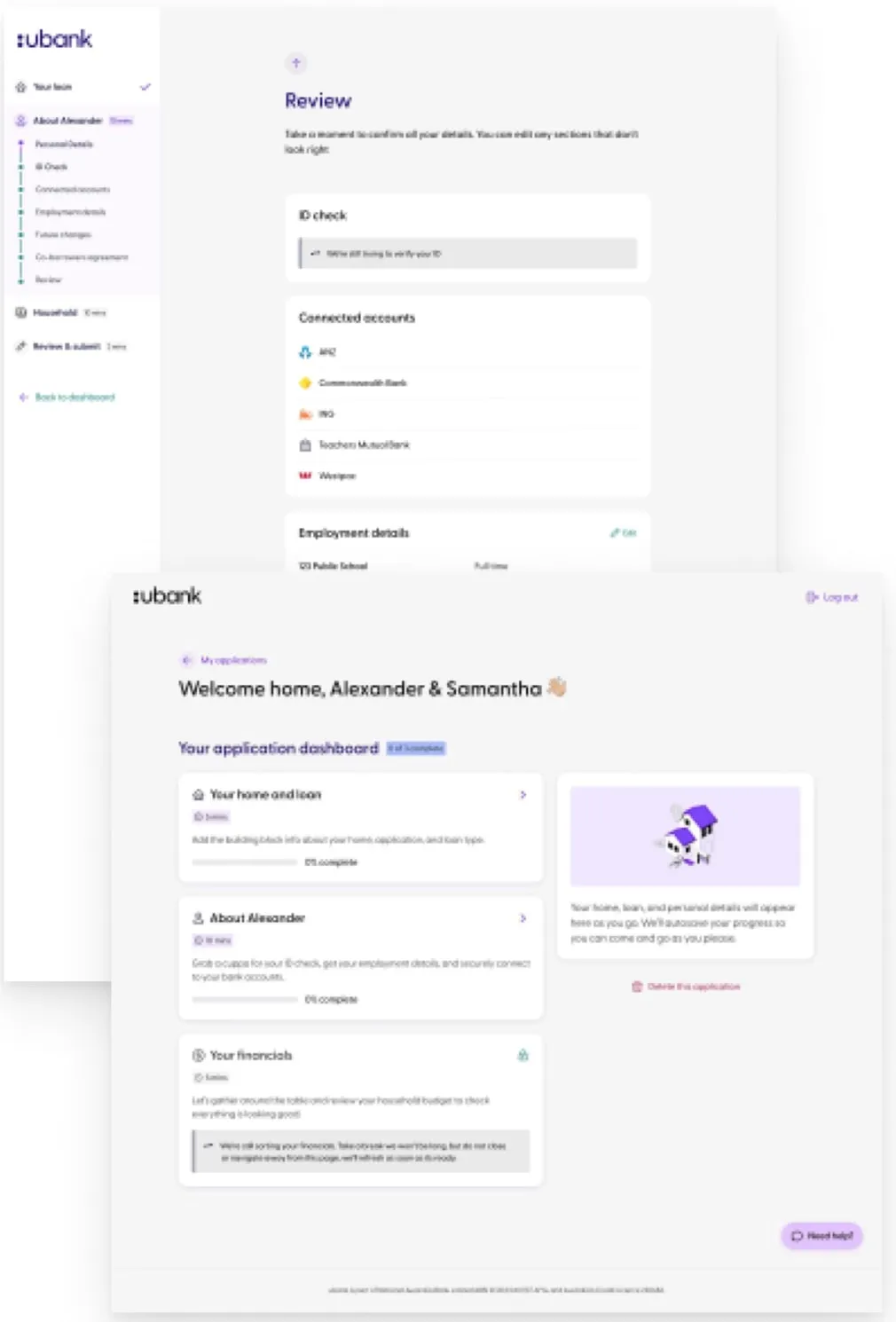
Beyond the start, I used Glassbox to watch live applications in near real time. It showed us where customers stalled, and the biggest blocker was a quiet one: the ID check and connected bank accounts could take longer than expected, and customers had no feedback. They sat on the dashboard, unable to move on to “Your financials” and unsure why.
The fixes were small and shipped within a sprint:
- An info banner on the review page showing the status of each check
- Banners on the application dashboard explaining what was happening and what to do next
The share of customers getting from getting started to submit rose 80%.
Getting the data right
The same live-data loop drove a run of fixes to the steps where customers entered or verified information. The biggest was at ID verification and connected accounts, where validation errors dropped from 26% to 1%.
The hard call: payslips
Income was verified by scraping customers’ bank transactions through illion. Many customers didn’t like sharing their accounts that way, and the scrape didn’t always work. Without verified income, applications came back needing more information.
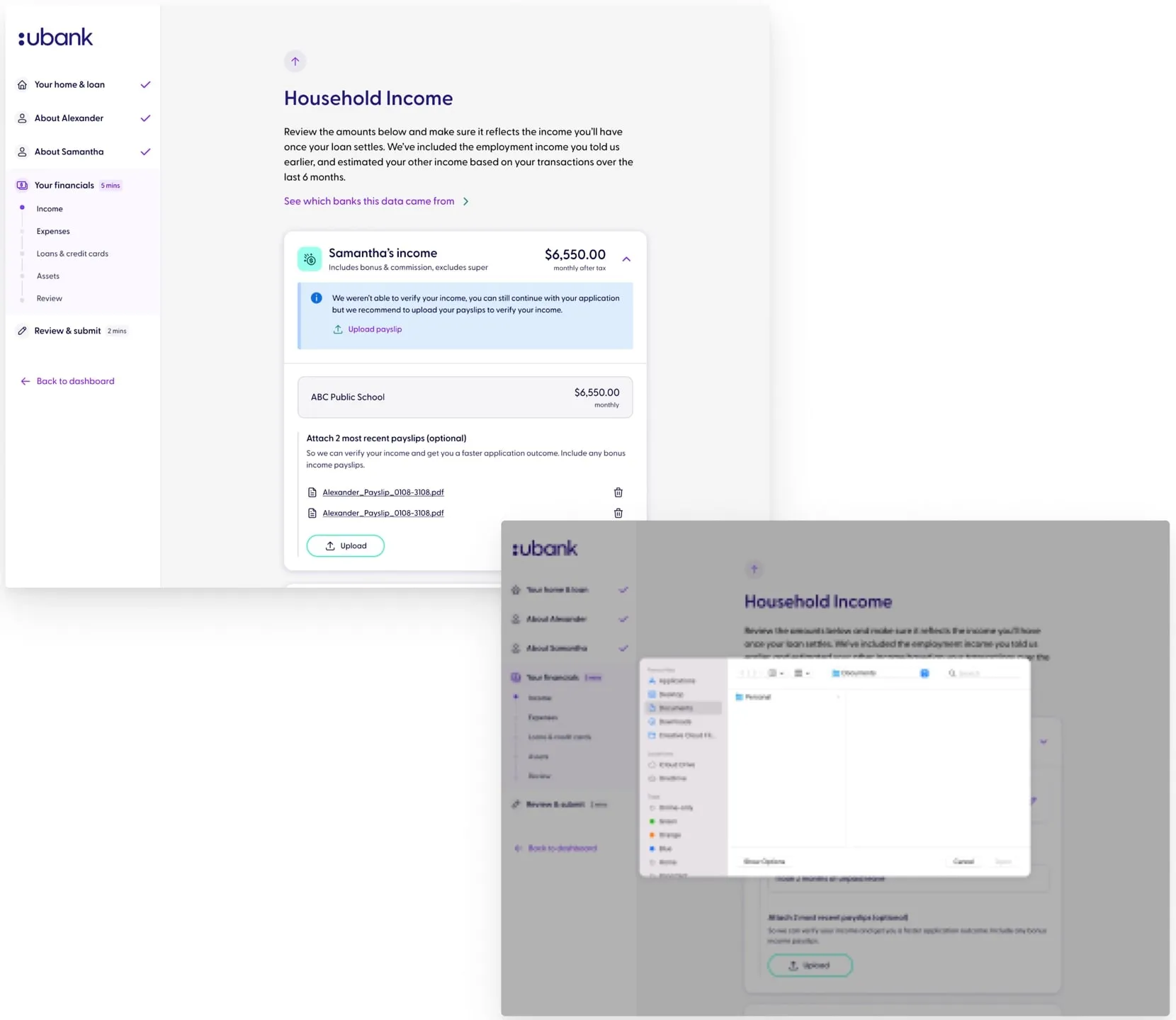
I designed a way to upload payslips inside the application:
- Researched standard upload patterns and what customers expected
- Reviewed the journey for where upload could fit
- Worked with architects on a standardised storage database for documents
- Designed the UI changes to the income flow
We held it. Open Banking was coming and would replace illion as the data source, so building more around the old scrape would have been effort spent on a system on its way out. The expected benefit, fewer applications needing more information, moved with the Open Banking work.
Getting approved: the expenses uplift
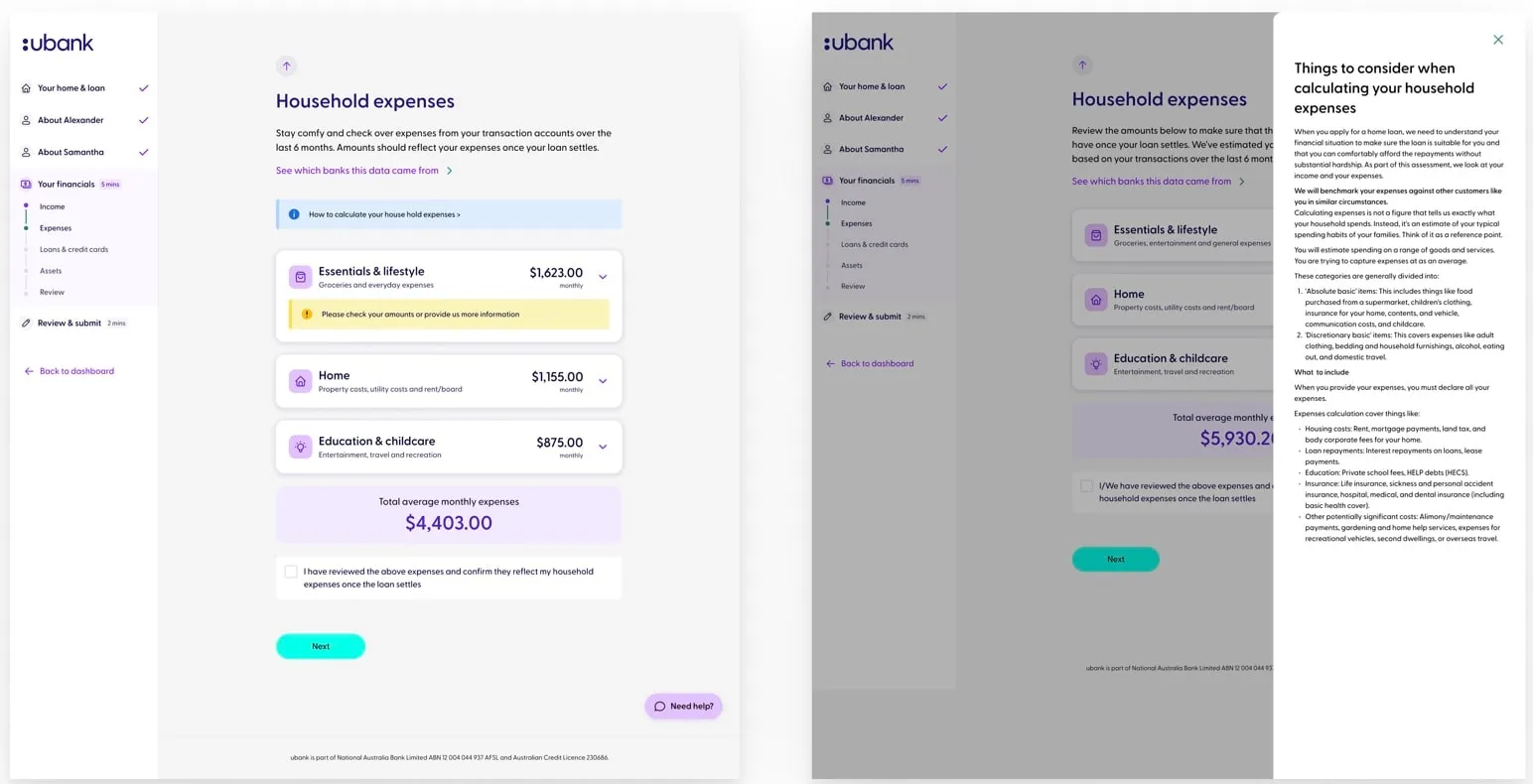
The expenses step asked customers to declare their household spending in categories. They started from $0, with no indication of what we’d scraped for each category or which categories were mandatory. My hypothesis was that this starting point was creating the struggle, and the inaccurate declarations that got applications rejected.
Learning the legislation. Home lending is heavily regulated, and I started out knowing nothing about the rules for expense declarations. I used NotebookLM to work through the Banking Code of Practice, ASIC’s responsible lending guidance (RG 209) and the HEM benchmarks. It let me map what was allowed, and where responsibility sat between the customer and the bank.
That changed how I worked with legal and risk. Instead of taking them a design and waiting for an answer, I went to them with the specific acts that applied to what we were trying to do, and the exact language that related to it. That reduced the work they had to do to assess it. A lawyer’s usual starting position is no, so getting agreement on how far we could go for customers was a huge win.
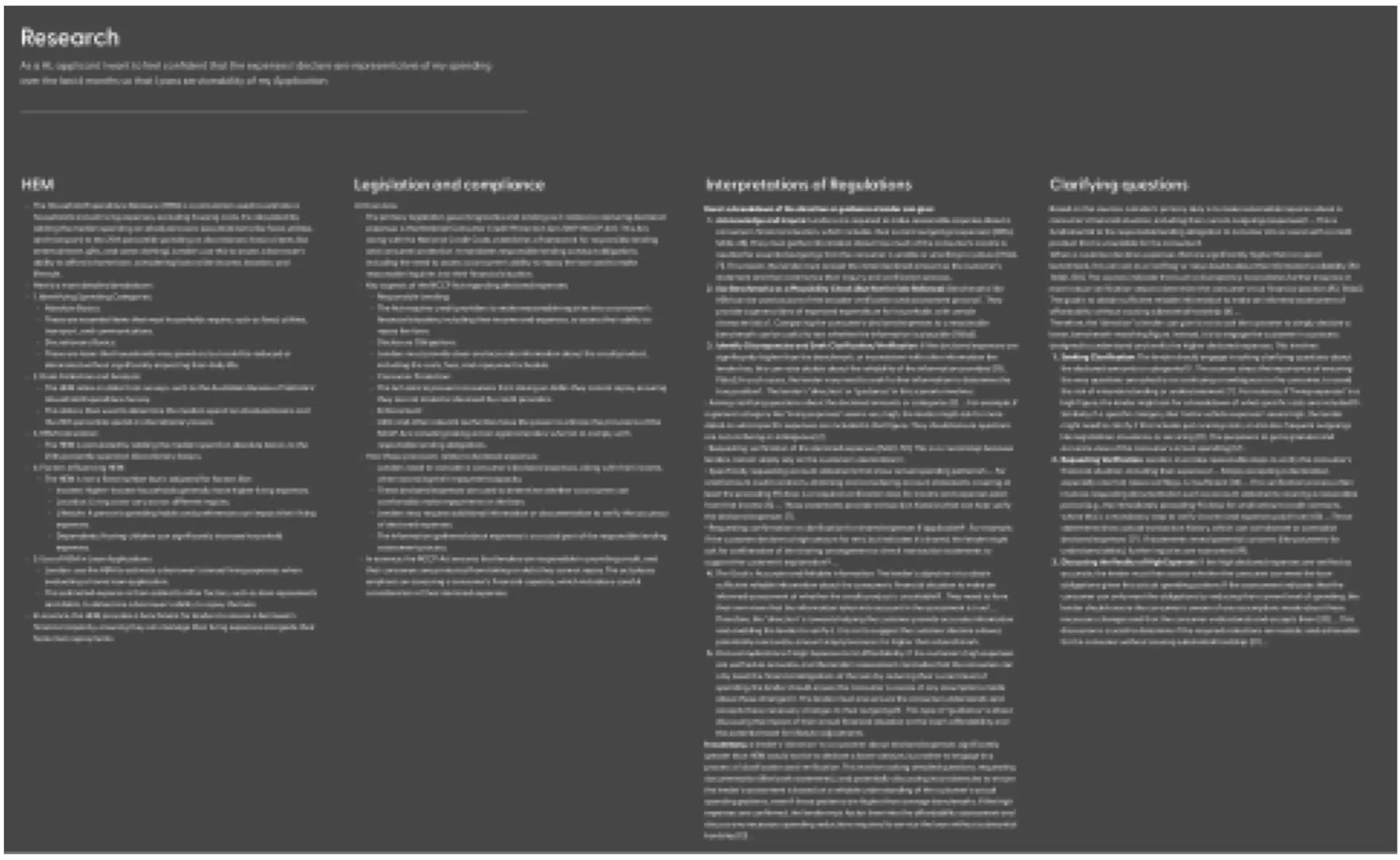

Learning from bankers. I interviewed bankers about how they handled expenses with customers in person. They guided customers through the tricky steps, which was exactly what the self-serve flow wasn’t doing. Helping bankers do that was the other half of my work at ubank: Loan Assist.
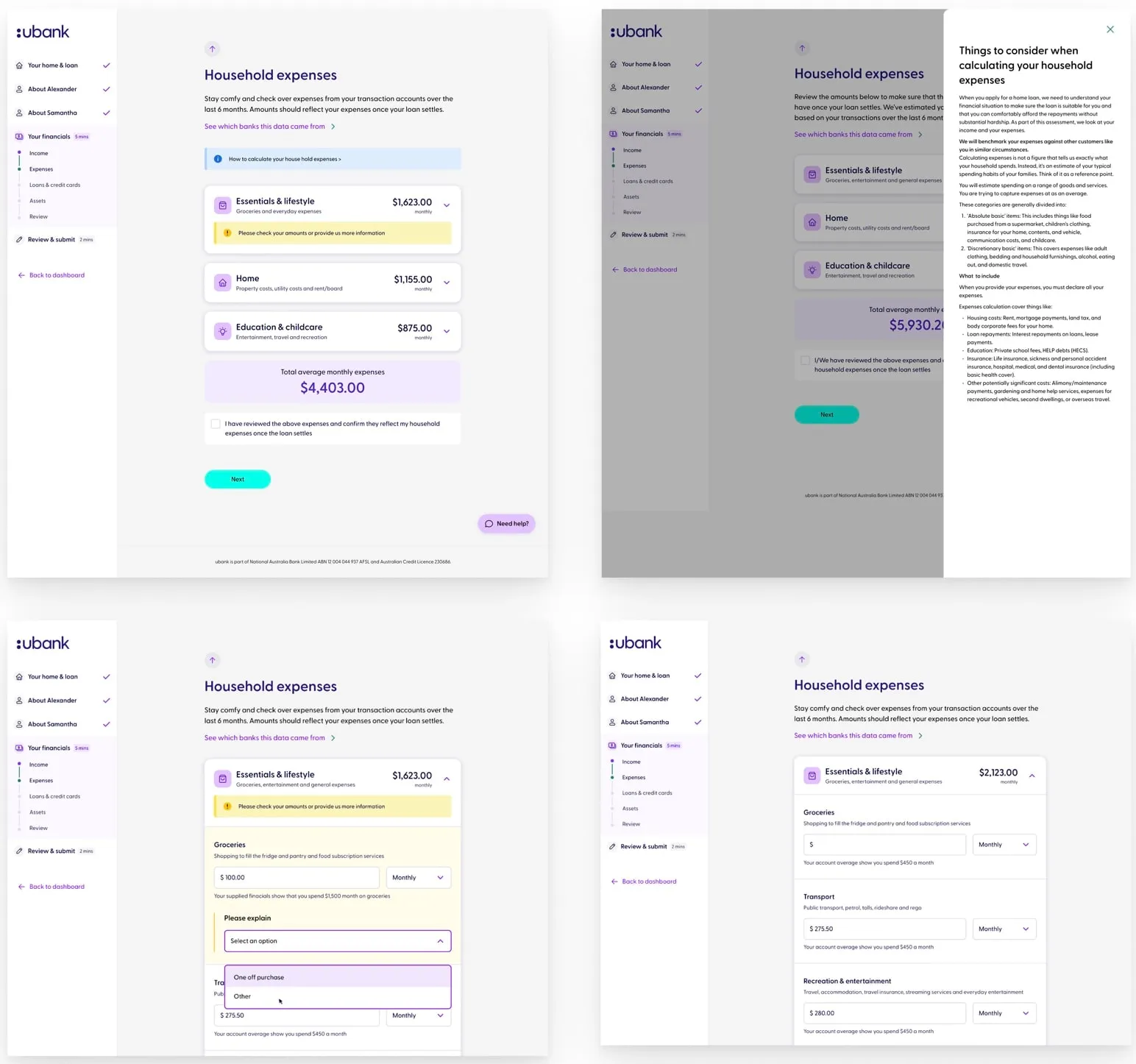
The design decision. The obvious fix was to pre-fill each category with the scraped figure. In practice, that made things worse. Customers just hit OK without reviewing the numbers, and because the scrape could put incorrect figures into fields, it often made them look like they spent more than they did.
So the scraped figure became a starting point, not an answer. It’s shown under each field as a reference, and the customer still enters their own figure. That makes the step a point of action and consideration, rather than a pre-populated form that’s easy to wave through.
Alongside that, I cleaned up the page:
- Total income and expenses summarised at the top
- The expense table in full view and quicker to fill in
- A sticky call to action
I tested the prototype with customers for comprehension and usability before it shipped. We also explored “customers like you” ranges, using data to show typical spending for a household’s relationship status, income and number of children, mirroring HEM.
Impact
Over 12 months, the squad took the application from 11% to 85% unconditional approvals. The change came at every stage:
- Getting through: application starts up 26%, and getting started to submit up 80%
- Getting the data right: validation errors at ID and connected accounts down from 26% to 1%
- Getting approved: 9% fewer applications rejected on HEM benchmarks, and fewer calls to lending teams about expenses
The lesson I took from it: for a self-serve product in a regulated space, the job isn’t to remove all friction. It’s to put the friction in the right place, where the customer needs to stop and think, and take it out everywhere else.